What makes this list different
Most "ChatGPT alternatives" lists are one writer's opinion dressed up as a ranking. This one was produced differently. We put the question to Synero's own council, which sends the same prompt to four frontier models from four providers (GPT, Claude, Gemini, and Grok) and synthesizes one answer that records where they agree and where they split. Then we did the part the models cannot do for themselves: we checked that every tool named is real and available today, and dropped anything speculative.
The result is a ranking that already survived four independent models disagreeing with each other, with the unverifiable parts removed. One honest caveat up front: "best" is meaningless without a use case. The list is ordered by how often the models converged on a tool, but the decision map at the end is the part you should actually use.
How Synero works
1Ask your question
Your question goes to GPT, Claude, Gemini and Grok. Each answers on its own.
2Get one answer
Synero writes one combined answer from the best of all four.
3See where they split
Agreement is a good sign. Disagreement tells you what to check.
The ranked list
1. Claude (Anthropic)
The standout across all four models for depth and reliability. Claude is strongest on long-context reasoning and careful analysis, with comparatively low rates of confident hallucination. If your work is writing, legal review, research, or anything where a fluent wrong answer is expensive, this is the default. Skip if you need live web data or deep integration into a specific app suite.
2. Google Gemini
Less a standalone chatbot than a reasoning layer woven through Search, Maps, Workspace, and real-time data. Nothing else matches its ecosystem reach. If your day already lives in Google tools, the workflow continuity is hard to beat. Skip if you are not in the Google ecosystem, where most of its edge disappears.
3. Perplexity
The clearest differentiator here: answers are grounded in cited, real-time web sources rather than trained weights, so it shows its work. The right pick for journalists, analysts, and students whose credibility depends on verifiable facts. Skip if you want long creative or reasoning-heavy generation, which is not its focus.
4. Meta Llama (open weights)
The only major frontier model on this list you can run yourself. Local or private deployment means no data logging, no usage limits, and no dependency on a vendor's policy changes. Three of the four models raised this independently. Best for developers and privacy-sensitive teams. Skip if you do not have the infrastructure or appetite to self-host.
5. Mistral
A consistent pick for strong multilingual performance, competitive efficiency, and lighter regulatory overhead than the US giants. Best for European companies and global teams with localization needs. Skip if raw frontier reasoning on English-only tasks is your only concern, where the top of this list leads.
6. Grok (xAI)
Its real edge is live integration with current social and news streams, so it reflects the present moment faster than models on static training data. Treat any "uncensored" framing critically; every model has guardrails, just configured differently. Best for journalists and market analysts tracking fast-moving events. Skip if you want a careful, conservative answer over a fast one.
7. DeepSeek
Underrated in Western coverage, but a serious contender: frontier-level capability at substantially lower cost, iterating quickly. Best for startups and high-volume API users who need strong reasoning without premium pricing. Skip if data-governance questions about where and how your prompts are processed are a dealbreaker.
8. IBM watsonx
The enterprise-compliance specialist. It does not compete on raw reasoning; it competes on auditability, regulatory integration, and embedding into regulated workflows. Best for healthcare, banking, insurance, and legal teams under strict compliance rules. Skip if you are an individual or a small team, where it is overkill.
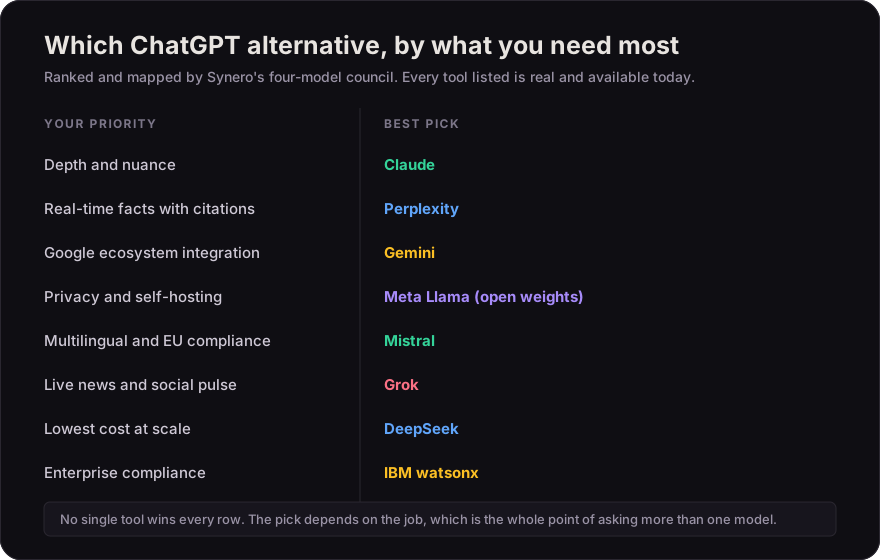
Pick by what you need most
Depth and careful analysis
- Go with
- Claude
Real-time facts with citations
- Go with
- Perplexity
Google ecosystem integration
- Go with
- Gemini
Privacy and self-hosting
- Go with
- Llama
Multilingual and European compliance
- Go with
- Mistral
Live news and social pulse
- Go with
- Grok
Lowest cost at scale
- Go with
- DeepSeek
Enterprise compliance
- Go with
- IBM watsonx
| Your priority | Go with |
|---|---|
| Depth and careful analysis | Claude |
| Real-time facts with citations | Perplexity |
| Google ecosystem integration | Gemini |
| Privacy and self-hosting | Llama |
| Multilingual and European compliance | Mistral |
| Live news and social pulse | Grok |
| Lowest cost at scale | DeepSeek |
| Enterprise compliance | IBM watsonx |
For independent, vendor-neutral performance comparisons, LMSYS Chatbot Arena remains the most credible public source.
See it in 30 seconds
The option this list points at
Notice that no single tool wins every row. That is the real finding, and it is the reason Synero exists. Instead of picking one alternative and trusting its lone answer, Synero runs several of these models at once on the same question and synthesizes them, so you see where they agree (higher confidence) and where they disagree (the part worth a second look). This very ranking was produced that way. If the lesson of the table is "the best tool depends on the job," the natural next step is to stop betting on one model per question.
How we made this
We asked Synero's four-model council to rank the best ChatGPT alternatives, kept the reasoning the models agreed on, and verified that every tool named is a real, available product before publishing. Where the models offered speculative version numbers, we removed them. Rankings reflect general capability as of 2026 and will shift as these tools evolve.
Ask ChatGPT, Claude, Gemini and Grok at the same time
Get one combined answer and see exactly where the AIs agree and where they split. Free to try, no card, private by default, and not used for training. Then $10 a month with $10 of usage included, or pay as you go with credit packs from $5, no subscription.