Short answer
Most tooling sold as "AI for engineering" answers a different question than the one your team actually has. It either ranks models to find the single best one for code, or it routes each task to one cheapest-capable model behind a gateway. For autocomplete and boilerplate, that is enough. For an architecture review, a security trade-off, or a 2am production debugging call, sending the question to a single model gives you one opinion, and nothing in the answer tells you whether it is correct or just fluent.
Synero takes a different posture. It sends the same engineering prompt to up to four frontier providers in parallel (GPT, Claude, Gemini, Grok), then reads all the answers together and writes one consensus answer plus an Agreement panel. You get a cross-provider second opinion on the exact decision in front of you, and the place the four answers disagree is the map of what is genuinely uncertain.
This is a walkthrough of how a single query moves through the council, annotated at each step with the real roster numbers we computed from Synero's own model catalog. We read the catalog directly rather than quote a pitch, so you can audit the correctness argument instead of taking it on faith.
Step 1: One prompt fans out to four providers at once
When you submit a question, you pick up to four models (one per provider) or a preset: Solo, Duel, Council, or Deep. Synero fires the requests in parallel, and each model answers the same prompt independently, with no knowledge of what the others said.
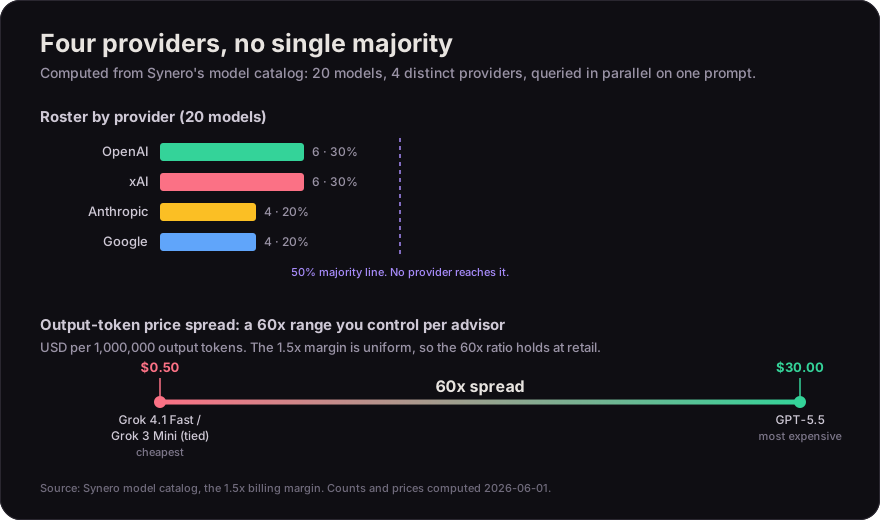
What the catalog shows. We grouped every entry in the model catalog by its provider and counted. The bench holds 20 models across 4 distinct providers: OpenAI, Anthropic, Google, and xAI. The split is 6 OpenAI, 6 Anthropic, 4 Google, 4 xAI. The largest single provider holds 6 of 20, a 30% share, so no one vendor owns a majority of the roster.
Why it matters here. The value of a second opinion collapses if every opinion traces back to the same training lineage. Pulling the four models from four separate providers is what makes Step 2 work, because models from different vendors fail in different ways.
How Synero works
1Ask your question
Your question goes to GPT, Claude, Gemini and Grok. Each answers on its own.
2Get one answer
Synero writes one combined answer from the best of all four.
3See where they split
Agreement is a good sign. Disagreement tells you what to check.
Step 2: Disagreement surfaces the blind spot
Run a real engineering question through this and the useful signal is not four tidy answers. It is the divergence between them.
A single model will confidently recommend an architecture, miss the failure mode you did not think to ask about, and never flag its own uncertainty. That is the dangerous case: confident and wrong, with nothing in the output telling you which. When four models from four providers answer the same prompt, a hallucinated API, a deprecated pattern, or a security trade-off that one model glosses over tends to get contradicted by at least one of the others. The contradiction is the alert.
Why the provider split is load-bearing. Models from the same provider share architecture, training data, and alignment choices, so they tend to share blind spots. Because no single vendor exceeds 30% of the 20-model roster, the four models you pick can always come from four separate providers. That is what keeps the disagreement informative instead of an echo of one lineage.
Step 3: The synthesizer reconciles, it does not vote
After the models finish, a consensus model reads all the responses and writes one answer. It is not a vote count and it is not an average. The synthesis notes where the models agreed (higher confidence), where they split (flagged as a genuine trade-off for you to decide), and where one model caught something the others missed.
The reasoning behind this design is that a synthesizer reading several independent answers can weigh a lone-but-correct dissent instead of burying it under a majority. For an engineering decision, that means you get one coherent recommendation plus an honest account of where the council was not unanimous, which is exactly the part a single model hides.
See it in 30 seconds
Step 4: You set the price point per model
Because you choose each model independently, you control cost per model without giving up provider diversity. The catalog's output-token prices span a wide range, which we computed directly from each model's per-token output price.
What the catalog shows. The cheapest output tokens belong to GPT-6 Luna and Claude Haiku 5.5, tied at $0.50 per million output tokens. The most expensive are GPT-6 Astra and Claude Fable 5.1, tied at $50.00 per million output tokens. That is a 100x spread between the priciest and cheapest token on the bench. Synero applies a uniform 1.5x margin to user-facing prices, and because that multiplier hits both ends equally, it cancels in the ratio. The 100x spread holds at retail.
Why it matters here. You can run a four-provider council mostly on the low end of the price range for everyday reviews, then swap one model for a top-tier flagship (GPT-6.1 Sol, Claude Opus 5.5, Gemini 3.1 Pro, Grok 4.7) when the stakes justify the premium. The provider diversity stays constant. The price is the dial.
Why this is a correctness safeguard, not a cost trick
Routing gateways optimize for sending each task to one cheapest-capable model. That is a procurement play, and it leaves you with the single-oracle problem: one answer, no way to see its blind spots. Synero's parallel-council approach optimizes for decision quality on high-stakes calls. The four-provider spread exists so that when a model is confidently wrong about your schema migration or your auth flow, another provider's model is likely to say so.
There is a resilience dividend on top of the correctness one. With 20 models across 4 providers and no provider over 30% of the bench, a single vendor's outage, rate limit, or model deprecation does not take your workflow down. You swap the affected model for one from another provider and keep going.
When to use the council, and when not to
- Use it for the high-stakes, open-ended call. Architecture reviews, security trade-offs, "is this design going to bite us in six months," gnarly debugging where the root cause is unclear. These are where four providers disagreeing earns its cost.
- Use a single model for the narrow follow-up. Once the council has framed the decision, drilling into one sub-point or generating boilerplate does not need four perspectives.
- Skip it when the answer is closed. A syntax question or a documented API signature has one right answer. Disagreement only helps when the question is genuinely open.
FAQ
Why four providers instead of the single best model for code?
Because "best model" gives you one opinion you cannot audit. The four-provider council exists so a confidently wrong answer from one model gets contradicted by another. You can pick models from 4 distinct providers with no single one above a 30% share of the 20-model roster, which is what keeps the disagreement meaningful instead of an echo of one training lineage.
Does running four models cost four times as much?
Not necessarily, because you pick the models yourself. Output-token prices in the catalog range 100x, from $0.50 per million (GPT-6 Luna and Claude Haiku 5.5) to $50.00 per million (GPT-6 Astra and Claude Fable 5.1). You can run everyday reviews on the low end and reserve top-tier models for the calls that warrant them.
What happens if one provider has an outage?
You swap that model for one from another provider. With 20 models across 4 providers and no vendor holding more than 30% of the roster, no single outage, rate limit, or deprecation stops the workflow.
Is the synthesizer just averaging the answers?
No. It reconciles them. Agreement raises confidence, disagreement is surfaced as a trade-off, and a point one model caught alone is preserved rather than diluted under a majority.
Try it on your next design review
Ask GPT, Claude, Gemini, and Grok the same engineering question and see where they split. Pick one model or a preset, and get a consensus answer plus an Agreement panel. See pricing ($10 a month with $10 of usage included), or read how Synero works and the developer API.
Try it free. A free account gets 3 questions, no card.
The roster figures on this page (20 models, 4 providers, 30% max single-vendor share, 100x output-price spread) were computed by Synero from its own model catalog with the 1.5x billing margin, on 2026-06-01 and refreshed against the current catalog on 2026-10-03. No human author is claimed. This page was produced by Synero's content pipeline.
Ask ChatGPT, Claude, Gemini and Grok at the same time
Get one combined answer and see exactly where the AIs agree and where they split. Free to try, no card, private by default, and not used for training. Then $10 a month with $10 of usage included, or pay as you go with credit packs from $5, no subscription.