The problem: a single AI is confident, and confidence is the trap
Most "AI tools for entrepreneurs" pages sell speed. Draft the email faster, summarize the deck faster, write the job post faster. That is fine for output. It is the wrong frame for the decisions that actually move a company.
The decisions that matter to a founder are the asymmetric ones: a pricing change, a key hire, how to frame a fundraise, when to pivot, which vendor to lock into. These calls are made on thin information and they are hard to reverse. The standard advice is to lean on one tool, ChatGPT or Perplexity, and take its answer.
A single model has a known weakness against that kind of call. It gives you one fluent, confident answer and hides where it is unsure. It will not volunteer that a credible opposing view exists unless you already knew to ask for it. For a decision you cannot easily undo, that hidden uncertainty is exactly the dangerous part. One model is a single point of failure for a decision: when it is wrong, it is wrong with no dissent in the room.
How Synero works
1Ask your question
Your question goes to GPT, Claude, Gemini and Grok. Each answers on its own.
2Get one answer
Synero writes one combined answer from the best of all four.
3See where they split
Agreement is a good sign. Disagreement tells you what to check.
The test: run one decision past four models, then synthesize
Synero runs your question through up to four frontier models at once, then a fifth pass writes one consensus answer and an Agreement panel that names where they agree and where they split. GPT, Claude, Gemini, and Grok weigh in independently, and the places they disagree are the blind spots you had not stress-tested.
We wanted to know what that actually costs a founder per decision, because the pitch only holds up if the price is trivial next to the call it informs. So we did not estimate. We read the rates straight out of Synero's own model catalog and the billing multiplier and computed it.
The example load is one real council query. Each of the four models reads 1,000 input tokens and writes 800 output tokens. The GPT-5.2 synthesizer reads the 4,000 tokens of combined answers and writes 1,000. Cost per call is input tokens times the input rate plus output tokens times the output rate. The lineup priced here is GPT-5.2, Claude Sonnet 4.6, Gemini 3 Flash, and Grok 4.3, the catalog as of 2026-06-01. Synero's flagships are newer now (GPT-6.1 Sol, Claude Opus 5.5, Gemini 3.1 Pro, Grok 4.7), so today's totals differ; the shape of the tradeoff does not.
The verdict: 6.62 cents to turn one opinion into four cross-checked ones
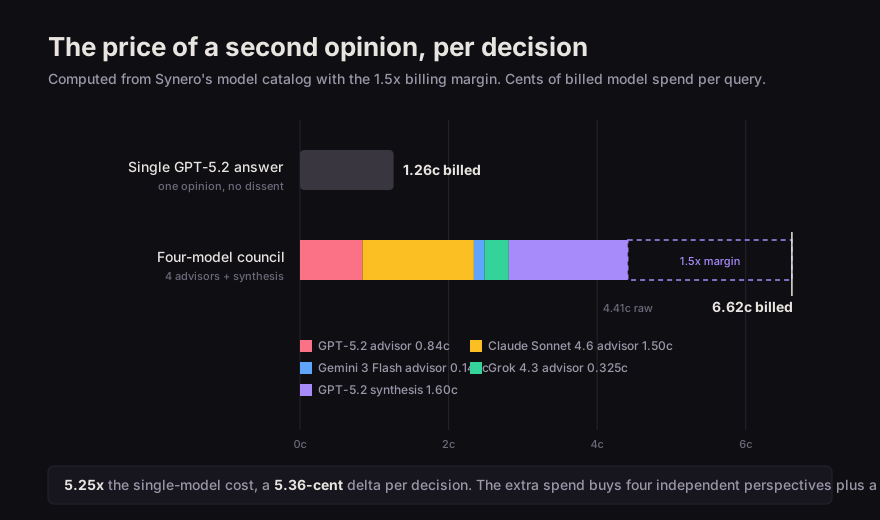
Here is the raw model spend, per model, computed from the catalog:
- GPT-5.2: $0.0084
- Claude Sonnet 4.6: $0.015
- Gemini 3 Flash: $0.00145
- Grok 4.3: $0.00325
The GPT-5.2 synthesis pass adds $0.016, for a council raw total of $0.0441, which is 4.41 cents. Apply the 1.5x margin and one full council query bills at $0.0662, or 6.62 cents.
The same question to a single GPT-5.2 costs $0.0084 raw and $0.0126 billed, which is 1.26 cents.
So a founder pays exactly 5.25 times more, a billed delta of $0.0536, to turn one opinion into four cross-checked ones plus a referee. The whole tradeoff is that one number: about 5.4 cents per decision.
That is the case the productivity framing misses. The council is not cheaper than one model, and we are not going to pretend it is. It is cheap insurance against being confidently wrong. Even at a few hundred high-stakes decisions a month, the diversification cost stays under $20. When the call is hard to reverse, paying about a nickel for four independent reads plus a synthesis that surfaces the disagreement is among the cheapest risk reduction available to a founder.
See it in 30 seconds
When the council is worth it, and when it is not
The math points to a clear rule.
- Use the council for asymmetric, hard-to-reverse decisions. Pricing changes, a key hire, a fundraise framing, a pivot, a vendor lock-in. These are the places where the disagreement between models is the signal, because that disagreement maps the part of the decision you have not stress-tested.
- Use a single model for the cheap, reversible work. Drafting copy, reformatting a doc, a quick factual lookup. Paying 5.25 times the price for four perspectives on a tweet is theater. The downside of getting it wrong is a minute of editing.
A practical pattern: run the council on the decision, then a single model on the execution that follows. That keeps most of your day near single-model cost while reserving the four-model cross-check for the calls where being wrong is expensive.
Caveats, honestly
- These are provider rates at one example token load with Synero's 1.5x margin applied. Your real cost moves with how long your question and the answers run. A long strategy memo costs more than this example, a one-line question costs less.
- The council is slower than one model. Four reads plus a synthesis means you wait longer. For anything reversible and quick, that wait is not worth it.
- More models does not turn a bad question into a good decision. The council surfaces disagreement and blind spots. It does not have your cap table, your team's context, or your judgment. It is a second opinion, not the decision-maker.
FAQ
Does running four models cost four times as much as one?
No, it is 5.25 times the billed cost of a single GPT-5.2 answer, not four times, because the synthesis pass and the differing per-model rates change the total. At our example load, the council bills 6.62 cents against 1.26 cents for one model, a 5.36-cent delta per decision.
Why pay the premium at all instead of just asking ChatGPT?
Because one model gives you one opinion with no dissent. The 5.36-cent delta buys four independent reads from four providers plus a synthesis that names where they disagree. The disagreement is what flags a confidently wrong answer before you act on it.
How were these numbers calculated?
We read each model's per-token input and output rates from Synero's model catalog, applied the example token load (1,000 in and 800 out per model, 4,000 in and 1,000 out for the GPT-5.2 synthesis), summed to a raw council cost of 4.41 cents, then applied the 1.5x billing margin to reach 6.62 cents billed.
Will the cost stay 6.62 cents?
Only for this exact load. The figure scales with how many tokens your question and the answers use, and it tracks the catalog rates. If the rates in Synero's model catalog change, the math changes with them.
Run your next big decision past four models
Pick up to four AIs, ask your question, and get a consensus answer plus an Agreement panel showing where they split. See pricing: one plan, $10 a month with $10 of usage included. More in use cases and how Synero works.
Try it free. A free account gets 3 questions, no card.
The figures on this page (4.41 cents raw and 6.62 cents billed for a four-model council, 1.26 cents for a single GPT-5.2 answer, a 5.25x ratio and a 5.36-cent delta) were computed by Synero on 2026-06-01 from its own model catalog with the 1.5x billing margin. No human author is claimed, and no figure here is sourced from outside that computation.
Ask ChatGPT, Claude, Gemini and Grok at the same time
Get one combined answer and see exactly where the AIs agree and where they split. Free to try, no card, private by default, and not used for training. Then $10 a month with $10 of usage included, or pay as you go with credit packs from $5, no subscription.