Best AI for fact-checking in 2026, ranked by what you are verifying
Compares five real verification tools at their current model versions across six fact-checking capabilities.
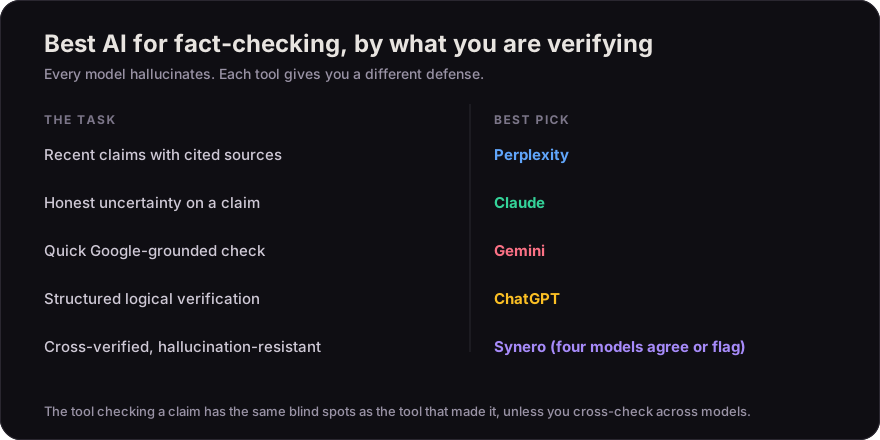
The hard part of AI fact-checking
Every AI model hallucinates, and the catch is that a model checking its own output has the same blind spots as the model that produced it. Asking one AI to verify another's claim is often grading the homework with the same flawed answer key. So the real question is not which model is most accurate, it is which tool gives you the best defense against a confident wrong answer.
This compares the five tools people use to verify AI claims, at current model versions, ranked by how much they actually protect you. No single tool is sufficient, and the strongest signal is agreement across independent models.
The tools, ranked for fact-checking
1. Perplexity
The fastest verifiable check. Every answer ships with source citations and real-time web search, so you can open the source and judge it yourself, which is exactly what verification needs. Limitation: a citation is not proof; the cited source can be wrong, and it favors speed over assessing conflicting sources. Best for: quick verification of recent claims with sources you can open.
2. Claude (Opus 4.7, Sonnet 4.6)
The most honest single model about its own uncertainty. It is more willing than most to say "I am not sure," and better at separating strong evidence from weak claims. Limitation: still one model with one set of biases, and without web access it cannot check against independent sources. Best for: careful claim assessment where honest uncertainty matters more than a confident answer.
3. Gemini (3.1 Pro, 3 Flash)
The Google-grounded check. Search grounding gives it real-time verification and broad coverage for surface-level fact-checks. Limitation: it can prioritize popular search results over accurate ones, and it is a single perspective with no adversarial check. Best for: quick fact-checks backed by Google Search.
4. ChatGPT (GPT-5.x)
Capable when explicitly pointed at verification, with strong logical reasoning chains and web browsing. Limitation: this is the model most prone to confidently presenting wrong information, and it cannot reliably detect its own hallucinations. Anything it asserts still needs an independent check. Best for: structured logical verification when you prompt it deliberately.
5. Synero
The closest thing to genuine automated fact-checking, because it does not rely on one model to grade itself. It runs a claim past four independently trained models from different labs: when all four agree, a shared hallucination is unlikely; when they disagree, you know exactly where the claim is shaky. The cross-check is the architecture. Limitation: no real-time web search for current events, and credits per query. Best for: deep claim verification where a hallucination is unacceptable.
How they score on verification
| Capability | ChatGPT | Claude | Gemini | Perplexity | Synero |
|---|---|---|---|---|---|
| Cross-model verification | None | None | None | Moderate | Strong |
| Hallucination detection | Weak | Moderate | Weak | Moderate | Strong |
| Source citations | Moderate | Weak | Moderate | Strong | None |
| Real-time verification | Moderate | None | Moderate | Strong | None |
| Uncertainty quantification | Weak | Moderate | Weak | Weak | Strong |
| Adversarial analysis | Weak | Moderate | Weak | None | Strong |
How to choose
Use Perplexity to check a claim against cited sources, especially for recent events. Use Synero for reasoning-based verification, where four independent models either agree (high confidence) or disagree (your signal to dig in). They are complementary: source-grounded checking plus cross-model consensus is a stronger defense than either alone, and far stronger than trusting one model to verify itself.
Notes
No tool eliminates hallucinations; cross-verification reduces the risk, it does not remove it. Model versions reflect the current generation as of 2026 and will change. Every tool named is a real, available product; ratings describe general fact-checking use, not a benchmark score.
Related
Put your question to the Council
Four frontier models answer independently, then Synero synthesizes one answer that shows where they agree and where they split.
Get Started