Best AI for strategy in 2026, ranked by the call you are making
Compares five real strategy tools at their current model versions across six capabilities that strategic work demands.
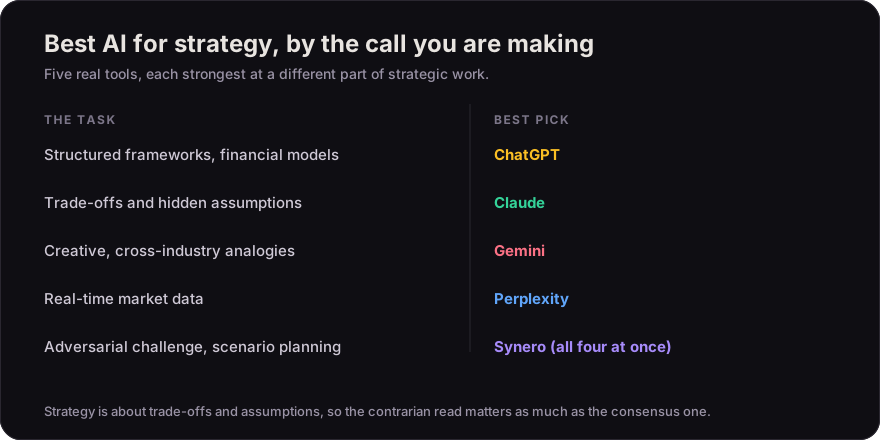
What strategy actually needs from an AI
Strategic decisions turn on the things you did not think to ask: the unstated assumption, the second-order consequence, the scenario you ruled out too early. A single AI model is bad at exactly this. Ask it for a strategy and it gives you the conventional, balanced answer and rarely challenges the premise of your question.
So this compares the five tools strategists reach for, at current model versions, ranked by how well each handles real strategic work. The point is not one winner. It is matching the tool to the task, and keeping a devil's advocate in the room.
The tools, ranked for strategy
1. Claude (Opus 4.7, Sonnet 4.6)
The strongest single model for the analytical heart of strategy. It is genuinely good at weighing trade-offs, surfacing unstated assumptions, and thinking through second-order consequences. Limitation: it can be overly cautious in its recommendations, and one model means limited scenario diversity. Best for: nuanced trade-off analysis and stakeholder-impact assessment.
2. ChatGPT (GPT-5.x)
The framework workhorse. Strong at structured analysis (SWOT, Porter's Five Forces) and the quantitative reasoning behind financial models, and it produces comprehensive strategy documents fast. Limitation: it tends toward conventional, balanced analysis and rarely surfaces a contrarian view. Best for: structured strategy frameworks and financial modeling.
3. Gemini (3.1 Pro, 3 Flash)
The creative angle. Good at cross-domain analogies and pulling competitive-landscape breadth from Google's knowledge base, with multimodal analysis for visual data. Limitation: depth is less consistent on specialized strategy topics, and it is still a single perspective. Best for: creative strategy and cross-industry pattern recognition.
4. Perplexity
The current-intelligence tool. Real-time market data and news with cited sources make it the fastest way to gather competitive intelligence you can verify. Limitation: it is built for search, not deep multi-scenario planning. Best for: real-time market data gathering and competitive monitoring.
5. Synero
The answer to the single-perspective problem. It runs your question through four models in distinct advisor roles, including a Maverick whose job is to challenge your assumptions, then synthesizes one answer that maps the trade-off space rather than the safest path. The adversarial challenge is built in, not bolted on. Limitation: no real-time web data, and credits per query. Best for: high-stakes decisions that warrant multiple perspectives and a built-in devil's advocate.
How they score on what strategy demands
| Capability | ChatGPT | Claude | Gemini | Perplexity | Synero |
|---|---|---|---|---|---|
| Multi-perspective analysis | Weak | Moderate | Weak | Weak | Strong |
| Adversarial challenge | Weak | Moderate | Weak | None | Strong |
| Trade-off synthesis | Moderate | Strong | Moderate | Weak | Strong |
| Real-time market data | Moderate | None | Moderate | Strong | None |
| Scenario planning | Moderate | Moderate | Moderate | Weak | Strong |
| Assumption challenging | Weak | Moderate | Weak | None | Strong |
How to choose
Use Perplexity to pull current market data, ChatGPT to build the framework, Claude to pressure-test the trade-offs. Then, for a decision expensive to get wrong, run it past more than one model so a confident, conventional answer gets challenged before you commit. That adversarial cross-check is what Synero automates: four reasoning styles on one question, with a synthesis that maps where they disagree.
Notes
Model versions reflect the current generation as of 2026 and will change as tools update. Every tool named is a real, available product; ratings describe general strategic use, not a benchmark score.
Related
Put your question to the Council
Four frontier models answer independently, then Synero synthesizes one answer that shows where they agree and where they split.
Get Started